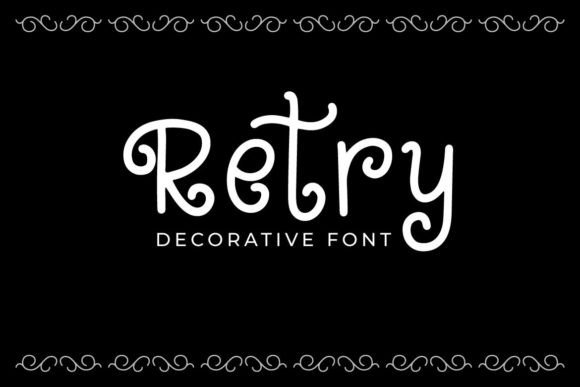
Retry: A Handwritten Font That Feels Like a Friend
You know the feeling. You’re staring at a blank canvas—be it a new brand deck, a set of wedding invitations, or a series of Instagram posts—and the default system fonts just aren’t cutting it. You need something with a pulse. Something that feels personal, approachable, and genuinely warm. Enter Retry, a handwritten font designed to bridge the gap between casual charm and professional clarity.
Unlike the rigid precision of a standard sans serif font or the authoritative stance of a traditional serif font, Retry brings a tactile quality to the screen. It mimics the natural flow of a marker or a fine-tipped pen, offering a creative font solution that doesn't sacrifice legibility for style. It’s the typographic equivalent of a firm handshake with a smile—confident, yet entirely unpretentious. If you are looking for a premium font that acts as a versatile design asset, this typeface deserves a spot in your toolkit.
The Visual Personality of a Modern Handwritten Typeface
When we talk about a handwritten font, there is often a worry that the text will become illegible or look too "messy" for brand identity work. Retry sidesteps this issue with a balanced x-height and consistent letterforms. It possesses a rhythmic quality that feels organic but is structured enough to maintain a professional hierarchy.
The visual appeal of Retry lies in its subtle imperfections. The strokes vary slightly in weight, mimicking the pressure of a human hand, which adds a layer of authenticity that modern typography often strives to replicate digitally. This isn't a frantic scrawl; it is a refined script font style that speaks to a relaxed, friendly aesthetic. Whether used in lowercase for a soft whisper or uppercase for a playful shout, the typeface maintains its composure.
For designers, this means you can use it for headers without overwhelming the viewer. It provides that sought-after "handmade" look that works exceptionally well in packaging design and artisanal branding. It signals to your audience that there is a human behind the product, which is a powerful psychological trigger in marketing and web design.
Practical Applications: Where Retry Shines
The versatility of a font is defined by its application. Retry is not just a one-trick pony meant only for greeting cards; it is a robust tool for various creative industries. Here is how different professionals can leverage this display font.
Branding and Logo Design
In logo design, distinctiveness is currency. A logo utilizing Retry immediately conveys a brand that is accessible, creative, and customer-centric. It works beautifully for lifestyle brands, boutique shops, eco-friendly products, or personal blogs. The font helps establish a brand identity that feels intimate rather than corporate. It pairs exceptionally well with a clean sans serif font for body text, creating a hierarchy that guides the eye naturally.
Digital Content and Social Media
For content creators and marketers, social media graphics need to stop the scroll. Retry offers the visual pop required for Instagram stories, TikTok overlays, and Pinterest pins. Its legibility at various sizes makes it a reliable choice for quotes, call-to-actions, and headers in web design elements. Because it mimics human writing, it increases audience engagement by making the content feel like a direct conversation rather than a broadcast.
Editorial and Publishing
In editorial design, contrast is key. Imagine a magazine layout with bold, gritty photography. Using a rigid sans-serif for pull quotes might feel too sterile. Retry introduces a softness that can break up the visual weight of a page. It is an excellent choice for subheadings in blogs or chapter titles in indie publications. It adds a touch of personality to publishing projects without distracting from the core content.
Strategic Font Pairing and Hierarchy
A great font pairing is like a good conversation—two distinct voices that complement each other. Because Retry has such a strong personality, it requires a partner that is stable and neutral.
- Retry + Geometric Sans Serif: This is a classic combination. The geometric precision of a font like Montserrat or Lato grounds the organic nature of Retry. Use Retry for H1 or H2 headers to draw attention, and the sans-serif for body text to ensure maximum readability.
- Retry + Slab Serif: If your brand has a vintage or industrial vibe, pairing Retry with a slab serif font can create an interesting tension between the mechanical and the organic.
- Retry + Monospace: For a more eclectic, tech-meets-artsy aesthetic, a monospace font can provide a cool, grid-like counterpoint to the flowing lines of Retry.
When building visual hierarchy, use Retry to highlight key information. If you are designing a flyer, let Retry handle the headline that grabs the eye, while a neutral typeface handles the "where" and "when" details. This ensures that your design remains functional while retaining its charm.
Evaluating Fit and Commercial Licensing
Before integrating any new design assets into your workflow, it is crucial to evaluate the fit and the licensing. Retry is a commercial font, meaning it is designed for professional use. This is a significant advantage over free alternatives, as premium fonts usually come with cleaner spacing, better kerning, and more reliable file formats.
When testing Retry for a project, consider the following:
- Context Testing: Don't just type "The quick brown fox." Place the font into your actual mockups. How does it look on a mobile screen versus a printed brochure? Does the character spacing hold up in long sentences?
- Weight and Style: Check if the font family includes variations like bold or italic. A single-weight font can be limiting for complex editorial design, but often, the stylistic alternates in a script font can compensate for a lack of weight variation.
- Readability at Scale: Handwritten fonts can sometimes break down at very small sizes. Test Retry at 12pt or 14pt to ensure the loops on letters like 'e' or 'a' don't close up and turn into blobs.
- Licensing Scope: If you are an agency or a business owner, ensure the license covers the number of users or the specific mediums you intend to use (e.g., web fonts vs. desktop fonts). Using a commercial font correctly protects your business legally.
Ultimately, Retry is more than just a collection of glyphs; it is a tool for connection. In a digital landscape often dominated by cold, geometric shapes, introducing a handwritten font like Retry can humanize your message. It tells your audience that you value warmth and creativity. Whether you are a small business owner designing your own packaging or a designer looking for that perfect accent typeface, Retry offers the flexibility and charm needed to elevate your work. It proves that sometimes, the best way to move forward is to try again—this time, with a little more personality.